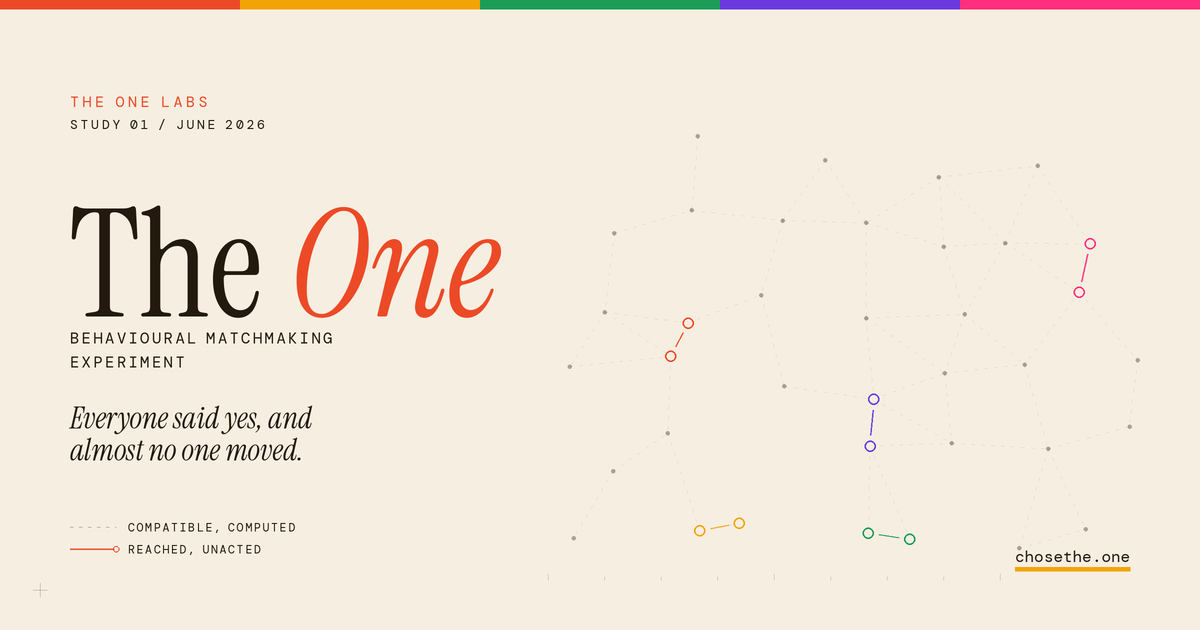
I ran this for two months. The engine did everything it was built to do, and the people it matched still didn't move. What follows is the whole record: how the thing worked, where it broke, and what those two months showed about the way we actually choose.
A small, curated pool and a machine that scored it
The One was a curated matchmaking experiment. People joined through a signup form, filled out a long profile covering their values, dealbreakers, intent, and the hard constraints like children, religion, food, and relocation, and a scoring engine then ranked compatibility across the whole pool. I read every match by hand before it went out, and no contact moved between two people until both of them agreed.
It ran two months on a deliberately small pool, small enough that I could read every profile and every match myself, big enough that the patterns weren't just noise. That scale is the whole point. What you're reading measures what people did when a real name and a real next step sat on the far side of the answer, which is a very different thing from what they'll tell a survey that asks nothing of them.
To watch how people choose when the choice is real
I wanted to know one thing: when someone picks a partner, do they choose the person they describe, or the person they're quietly protecting themselves from? Dating apps can't answer that, because nothing on them costs anything. A swipe is free. So I made a setting where saying yes led to an actual person, and the answers finally carried a price.
I ran it as an experiment with a matchmaker attached, rather than a product with data attached. The matchmaking was the instrument; the behaviour was the finding. That framing is why The One Labs exists now, publishing at chosethe.one, and why this counts as its first study.
The machine, honestly
No app, no funding. The database was a Google Sheet and the engine was a script that ran over it once a day, and that was the entire stack. It was enough, because the hard part was never the software.
People moved through three forms. The first put them in the pool; the second, longer one built the real profile; the last went out only when a match was ready, asking a single thing before any introduction, whether they were still available and whether they agreed to be introduced. I shared contact details only after both sides said yes.
Each day the engine paired everyone against everyone and made two passes. The first threw out pairs on the things that can't bend: opposite intent, a stated dealbreaker, a must-match on religion or food, an age gap outside someone's limit, one person wanting children and the other not. The second scored whatever survived, weighting shared values highest, then lifestyle, location, openness, attraction, personality, and age proximity. I never showed anyone more than three matches at once, so nobody drowned in options.
On rigour. This was a behavioural experiment on a small, self-selected pool, not a clinical study. Nobody who signs up for an invite-only matchmaking experiment is a random sample of anything, so read the numbers below as direction and rough size of a gap rather than precision you can bank on.
On privacy. Every figure here is an aggregate. Nothing in this writeup points to a single person, and no profile, message, or contact detail shows up in it anywhere. I deleted the raw participant data when the experiment closed, exactly as everyone was told I would.
The drop wasn't at signup. It was at motion.
I expected people to fall away at the paperwork. They didn't. Almost everyone who signed up finished the long profile and stayed available for weeks. The shape went from signup, to a completed profile, to an active pool, to a real introduction, to actually reaching out, and the collapse sat right at the end. Roughly a quarter of everyone who joined reached a real introduction. Almost none made it past that.
The consent step was where I expected the real drop, and it never came. When a match was ready I asked one blunt question, whether they were still available and whether they agreed to an introduction, and almost everyone said yes. Five pairs even reached a mutual yes, both people agreeing to meet. Then all five of those introductions went nowhere, not a first message between any of them.
Every free step got a yes. The one step that cost something, reaching out to a real person, got silence.
Compatibility wasn't the wall, and neither was willingness on paper. What stopped everyone was the short step from saying yes to actually reaching out, and almost nobody took it.
Five things the pool revealed
The scarce side quietly controlled everything that came after
At signup three in four people were men, so women were already outnumbered, roughly one to four. Then it got worse, because women stepped back faster than men, and the active pool the engine actually ran on each day drifted closer to five men for every woman.
Once one side is that rare, it quietly sets the rules for everyone: who gets seen, who gets to be picky, how hard the other side has to work for a single match. None of that was designed; it fell straight out of the ratio. The pool was thin geographically too, with Bangalore alone making up more than a quarter of it and a Delhi cluster next, which squeezed an already narrow pool further.
No engine turns a small, lopsided pool into a big, balanced one. The composition wrote the ending before the engine scored a single match.
What people say they want is not what they screen for
The values people listed were warm and open. Three in five named honesty, a little over half named respect, and close to half named commitment. Read only that column and you'd meet a generous, easygoing crowd.
Then read the dealbreakers, and a far more guarded person shows up. The most common one, by a clear margin, was a lack of ambition, named by more than half the pool and by roughly three in four of the women, with financial stability close behind. Taken as a group, the dealbreakers read like a risk assessment.
The values answer is who someone wants to be seen as. The dealbreaker answer is what they're quietly protecting themselves from. If you want to know a person, read the second one.
People go vague on the questions that decide a relationship
The easy questions got confident answers; the load-bearing ones got a maybe. Half the pool was unsure about children, about half were only maybe open on religion, and most hedged on relocation. Even attraction came back as a soft somewhat far more often than a clear yes.
A maybe isn't flexibility. It usually means the question is too expensive to answer honestly. People commit hardest to the answers that cost them nothing, and they go vague exactly where a truthful answer might cost them a match.
Everyone wanted something serious, and it still went nowhere
The easy explanation would be that people wanted different things. They didn't. Not one woman in the pool was after something casual, and the men skewed serious too, with fewer than one in five wanting anything casual at all. On paper, this was a room full of people chasing the same kind of thing.
Aligned intent wasn't enough. Two people could want the same future, fit on values, clear every hard filter, and still never send that first message. The problem was never that they wanted different things; it was that wanting turned out to be a long way from doing.
People believe one thing and do another
Every finding here is one version of the same gap. People performed virtue in the values column and quietly logged their fears in the dealbreakers column. They wanted something serious and said so out loud. Five pairs reached a mutual yes, both people agreeing to be introduced, and not one of those five turned into anything.
The engine did its job. It cleared the incompatible pairs and scored the rest, then handed people matches that genuinely fit, and still the matches went nowhere, because what stood between two compatible people was never information. It was intent.
The experiment is closed. The observations are not.
I kept fixing the matching. It was the wrong thing to fix.
The supply problem showed up early, so I did something about it. I emailed the men in the pool and asked them to refer women they knew, promising no photos, no phone numbers, and no contact without consent. It helped a little. It didn't move the ratio.
Most of my effort went into the engine. There was a bug where certain age gaps slipped past the filter, so I rebuilt the age logic and started flagging the edge cases for manual review. I taught location to understand that Delhi and Gurugram are near rather than far, then broke a blunt openness score into separate religion and age dimensions and added age proximity as its own signal. Version after version, the matching got sharper.
None of it moved the outcome. Better matches didn't produce more meetings, and that was the lesson I didn't want: the matching was never the bottleneck. You don't build a better matchmaker. You fix who walks in the door, and whether anyone's willing to move once they're inside.
That's the pivot. In my head The One stopped being a matchmaking service and turned into a way to study how people actually decide. The engine was only ever the microscope; the finding was whatever it pointed at.
The first of many
The experiment closed in June 2026 and I deleted the participant data, as everyone was promised. What's left is the pattern, and the pattern is worth more than any single match would have been. The One Labs keeps going, at chosethe.one, as a place to run small, real-stakes experiments on how people decide, and to publish what the data actually says.
People don't choose what they describe. They choose what they're protecting themselves from, and they're slow to admit which one it is.